

3D NAND Flash Memory Market Overview
3d nand flash memory market size was valued at USD 33350.22 million in 2025 and is poised to grow from USD 40220.37 million in 2026 to USD 217029.8 million by 2035, growing at a CAGR of 20.6% during the forecast period (2026-2035).
The 3D NAND Flash Memory Market is undergoing rapid structural expansion as semiconductor manufacturers increase vertical stacking, improve memory density, and optimize storage architectures for data-intensive workloads. The market is increasingly influenced by artificial intelligence infrastructure, enterprise solid-state drives, high-capacity consumer devices, automotive electronics, and connected medical equipment. TLC Type is estimated to account for approximately 78% of market demand, reflecting its balance between storage density, performance, endurance, and cost. At the same time, advances in wafer bonding, vertical channel formation, advanced controller integration, and higher-layer architectures are allowing manufacturers to increase capacity without relying solely on greater planar die area. The transition toward architectures exceeding 300 layers is also strengthening the focus on manufacturing precision, power efficiency, yield improvement, and reliability across high-volume NAND production.
The USA remains an important market for 3D NAND Flash Memory because of strong demand from cloud infrastructure, enterprise storage, artificial intelligence systems, automotive electronics, and advanced consumer devices. North America is estimated to represent approximately 17% of global market demand, supported by increasing deployment of high-capacity SSDs and data-intensive computing systems. AI-oriented data centers are encouraging storage providers to deploy higher-density NAND solutions capable of handling large datasets, while automotive and medical applications are increasing requirements for reliable non-volatile memory. Continued investment in semiconductor manufacturing, storage infrastructure, and advanced computing is expected to sustain demand for high-performance 3D NAND solutions across the United States.
Download Free sample to learn more about this report.
Key Findings
- Leading Product Type: TLC Type is expected to retain market leadership with approximately 78% share, supported by its combination of density, endurance, performance, and cost efficiency across consumer and enterprise storage applications.
- Leading Application: Consumer electronics is projected to represent approximately 55% of market demand, driven by increasing storage requirements in smartphones, computing devices, gaming hardware, and other data-intensive electronic products.
- Leading Region: Asia Pacific is expected to lead the global market with approximately 68% share, supported by concentrated semiconductor manufacturing, large electronics production bases, and extensive NAND supply-chain infrastructure.
- Fastest Growing Region: North America is projected to record approximately 23% annual growth, supported by AI data centers, enterprise SSD deployment, cloud infrastructure expansion, and increasing demand for high-capacity storage systems.
- Technology Trend: Ultra-high-layer 3D NAND architectures are reshaping storage technology, with leading development roadmaps moving beyond 400 layers to improve bit density, power efficiency, and capacity per wafer.
- Market Driver: AI infrastructure is becoming a major demand catalyst as enterprise storage requirements expand rapidly, with high-capacity SSD configurations increasingly requiring multi-terabyte NAND architectures for data-intensive workloads.
- Competitive Landscape: The competitive environment remains concentrated around 6 major supplied companies, with manufacturers accelerating process transitions, advanced-layer development, capacity optimization, and specialized SSD solutions to strengthen market positions.
- Future Outlook: The market is projected to expand at a 20.6% CAGR from 2026 to 2035, reflecting sustained adoption of high-density NAND across consumer electronics, automotive, medical equipment, and advanced computing systems.
Latest Trends
The most significant technology trend in the 3D NAND Flash Memory Market is the rapid movement toward higher vertical layer counts and improved bit density. Manufacturers are increasingly pursuing architectures above 300 layers, while next-generation development is moving beyond 400 layers to address growing storage requirements without proportionally increasing silicon footprint. Higher-layer structures can increase the number of memory cells available within a die, supporting larger-capacity SSDs and storage products. Advanced wafer-bonding approaches are also becoming more important because separating logic and memory-array manufacturing can improve scaling flexibility, manufacturing efficiency, and performance. These developments are particularly relevant to AI infrastructure, where storage systems must handle large datasets, frequent data movement, and increasingly demanding workloads.
Another important trend is the increasing differentiation between performance-oriented and capacity-oriented NAND solutions. TLC Type continues to serve applications requiring a balance between speed, endurance, and density, while manufacturers are advancing higher-density architectures for large-scale storage environments. Enterprise SSD demand is encouraging development of higher-capacity NAND products with improved interfaces, lower power consumption, and stronger reliability characteristics. Consumer electronics remains a substantial demand center because smartphones, computers, gaming systems, and other devices continue to require greater local storage. Automotive electronics and medical equipment are also increasing their use of non-volatile memory as software content, sensor data, navigation information, diagnostic records, and connected functions become more sophisticated.
Market Dynamics
Driver
""Artificial intelligence is accelerating demand for high-density storage.""
Artificial intelligence infrastructure is becoming one of the strongest demand drivers for 3D NAND Flash Memory because AI training, inference, data preparation, and model-serving environments generate large quantities of information that must be stored and accessed efficiently. Enterprise data centers are increasingly deploying high-capacity SSDs alongside advanced computing systems, creating demand for NAND architectures that provide high density without excessive power consumption. AI-related storage requirements are also increasing the importance of sequential and random data performance, endurance, latency, and capacity per device.
The expansion of high-capacity enterprise storage is reinforcing demand for advanced 3D NAND architectures with larger die capacities and improved interfaces. Manufacturers are therefore increasing investment in higher-layer processes, wafer-bonding techniques, and optimized memory-array designs. Consumer electronics adds another demand layer because devices increasingly incorporate higher-resolution media, artificial intelligence functions, games, applications, and locally stored content. With the overall market projected to grow at a 20.6% CAGR between 2026 and 2035, expanding data volumes are expected to remain a fundamental demand catalyst throughout the forecast period.
Restraint
""Complex scaling requirements increase manufacturing difficulty and cost pressure.""
Increasing the number of vertical layers introduces substantial process complexity because manufacturers must maintain alignment, channel uniformity, material stability, electrical characteristics, and structural reliability across increasingly tall memory stacks. Moving beyond 300 layers requires tighter control of deposition, etching, wafer handling, and process integration. As layer counts rise toward and beyond 400, manufacturers must address additional wafer-stress and reliability considerations while maintaining commercially acceptable yields.
Manufacturing complexity can also increase capital requirements because advanced 3D NAND processes depend on specialized deposition, etching, lithography, wafer-bonding, inspection, and testing capabilities. Yield losses can have a significant effect on production economics when memory structures contain hundreds of vertically stacked layers. In addition, NAND manufacturers must balance investment in new process generations with demand conditions across consumer electronics, enterprise storage, automotive, and medical applications. These factors can slow the transition between technology generations when expected capacity utilization does not justify immediate expansion.
Opportunity
""AI storage and high-capacity SSDs are opening new growth opportunities.""
AI data centers, cloud computing, enterprise applications, and large-scale analytics are creating opportunities for higher-capacity NAND products. Modern data infrastructure requires storage systems capable of holding increasingly large datasets while providing rapid access for processing and retrieval. This environment favors 3D NAND architectures that can deliver higher capacity within compact physical packages. The opportunity extends beyond conventional enterprise storage because AI-enabled applications are also increasing storage requirements in workstations, edge computing systems, automotive platforms, and connected devices.
Automotive applications represent another expanding opportunity as vehicles incorporate more electronic control systems, advanced driver-assistance functions, navigation databases, infotainment platforms, camera systems, and software-defined features. Medical equipment similarly generates demand for dependable non-volatile memory for imaging, diagnostics, patient records, embedded software, and device data. Consumer electronics remains the largest application category at approximately 55%, but increasing diversification into automotive and medical equipment can create additional demand streams. Manufacturers that improve endurance, reliability, density, and power efficiency can address a wider range of application requirements as storage intensity increases.
Challenge
""Higher density must be achieved without compromising reliability and efficiency.""
The central technical challenge for the 3D NAND Flash Memory Market is maintaining performance and reliability as memory structures become taller and cell dimensions become increasingly compact. Higher layer counts create more demanding requirements for channel formation, electrical uniformity, wafer stability, thermal management, and error correction. Manufacturers must simultaneously increase density and maintain acceptable endurance, retention, read performance, write performance, and operating stability across large production volumes.
Another challenge involves balancing performance and capacity requirements across different applications. Enterprise SSDs may prioritize endurance and sustained performance, while consumer electronics frequently emphasize capacity, cost, and energy efficiency. Automotive systems can require long operating lifetimes and stable performance across demanding environmental conditions, whereas medical equipment may place greater emphasis on reliability and data integrity. The market therefore requires manufacturers to optimize multiple parameters rather than pursuing density alone. As the industry advances toward architectures beyond 400 layers, maintaining consistent manufacturing yields and dependable device characteristics will remain essential to commercial scalability.
Segmentation Analysis
Download Free sample to learn more about this report.
Download Free sample to learn more about this report.
By Types
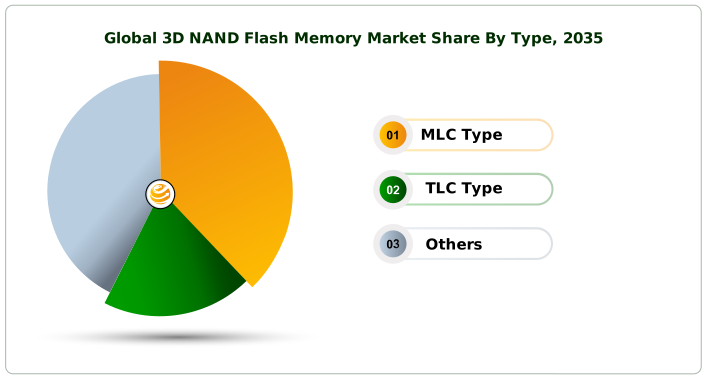
MLC Type: MLC Type is estimated to account for approximately 14% of the 3D NAND Flash Memory Market. MLC stores 2 bits per cell and continues to serve applications where a balance between endurance, reliability, performance, and storage density is important. Although higher-density NAND technologies have expanded rapidly, MLC remains relevant in selected industrial, embedded, enterprise, and specialized storage environments where write endurance and predictable performance are valued. Continued improvements in controller technology and error-management techniques are helping extend the usable role of MLC-based architectures across specialized applications.
TLC Type: TLC Type represents approximately 78% of the market and remains the dominant product category because it stores 3 bits per cell while providing a practical balance between capacity, performance, endurance, and manufacturing economics. TLC technology is widely suitable for consumer electronics, enterprise SSDs, computing devices, automotive platforms, and other storage-intensive systems. Increasing demand for multi-terabyte storage is strengthening its position, while improvements in controller algorithms, error correction, firmware optimization, and NAND process technology continue to improve practical performance. The segment is expected to maintain its leadership throughout the 2026–2035 forecast period.
Others: Others account for approximately 8% of the market and include alternative 3D NAND configurations serving specialized performance, capacity, endurance, or application requirements. Demand within this category is influenced by the development of advanced memory architectures and application-specific storage solutions. As layer counts move beyond 300 layers and next-generation designs approach or exceed 400 layers, manufacturers are evaluating different cell configurations and process approaches to improve density and efficiency. The segment can therefore benefit from continuing semiconductor innovation and diversification of NAND solutions across emerging storage requirements.
By Application
Consumer Electronics: 3D NAND Flash Memory is widely used in consumer electronics because modern devices require increasingly larger storage capacities for applications, operating systems, photographs, videos, games, and AI-enabled features. Smartphones, tablets, personal computers, gaming devices, digital cameras, and connected electronics increasingly depend on high-density NAND solutions. TLC Type remains particularly suitable because it combines storage density, performance, endurance, and cost efficiency. Higher-layer 3D NAND architectures are enabling manufacturers to increase capacity within compact packages while improving power efficiency.
Medical Equipment: Medical equipment represents an important application area for 3D NAND Flash Memory because modern healthcare devices generate and process increasing quantities of digital information. Diagnostic systems, imaging equipment, monitoring devices, laboratory instruments, and portable medical technologies require reliable non-volatile storage for operating software, patient-related information, diagnostic records, and device-generated data. 3D NAND provides high storage density within compact physical designs, supporting equipment where space and power efficiency are important. Manufacturers also require dependable endurance and data retention characteristics for long-term operation.
Automotive: Automotive applications are becoming increasingly important for 3D NAND Flash Memory as vehicles incorporate greater electronic content, connectivity, software, and data-processing capabilities. Modern vehicle platforms can require storage for infotainment systems, navigation databases, advanced driver-assistance functions, digital maps, camera information, operating software, and other embedded applications. 3D NAND provides high-density storage while supporting compact electronic architectures. Automotive systems also require dependable operation across extended vehicle lifecycles and demanding environmental conditions. Increasing adoption of connected vehicles, and software-defined vehicle architectures is creating additional storage requirements.
Others: The Others segment includes applications outside Consumer electronics, Medical equipment, and Automotive, covering diverse systems that require high-density non-volatile storage. Enterprise storage, industrial equipment, networking systems, embedded computing platforms, and specialized electronic devices can use 3D NAND for operating software, application data, configuration information, and local storage. Higher-layer architectures are particularly useful where large capacity must be delivered within compact physical packages. TLC Type can provide an effective balance of density and performance for many of these applications, while specialized configurations can address different endurance requirements.
Regional Outlook
Download Free sampleto learn more about this report.
Asia Pacific
Asia Pacific is the leading regional market for 3D NAND Flash Memory, accounting for approximately 68% of global demand. The region benefits from a highly concentrated semiconductor manufacturing ecosystem, extensive electronics production capacity, established component supply chains, and strong demand for smartphones, computing products, storage devices, and automotive electronics. Large-scale NAND manufacturing operations and supporting semiconductor infrastructure provide the region with a substantial position across the memory value chain. Consumer electronics is particularly important because the region supports production and consumption of multiple device categories requiring increasingly high storage capacities.
Asia Pacific is also benefiting from continued semiconductor investment, advanced packaging development, and expansion of data-center infrastructure. Manufacturers are increasing their focus on higher-layer 3D NAND architectures, with technology roadmaps progressing beyond 300 layers and toward more than 400 layers. Demand from enterprise SSDs, artificial intelligence infrastructure, mobile devices, and connected automotive systems is creating additional opportunities. The region's 68% share therefore reflects both its manufacturing concentration and its broad downstream electronics base, making Asia Pacific the principal geographic center of the 3D NAND Flash Memory Market.
North America
North America represents approximately 17% of the global 3D NAND Flash Memory Market and is becoming increasingly important because of its expanding AI infrastructure, cloud computing capacity, enterprise storage requirements, and advanced semiconductor ecosystem. Large-scale data centers require high-capacity storage systems capable of handling substantial datasets, model-development workloads, application data, and frequent information movement. Enterprise SSD deployment is consequently supporting demand for higher-density NAND products with improved endurance, performance, and power efficiency.
North America is projected to be the fastest-growing regional market, with annual expansion of approximately 23% during the forecast period. The region's growth is supported by AI-focused computing investment, cloud infrastructure expansion, enterprise digitization, automotive electronics, and increasing storage requirements across advanced computing environments. Demand for high-capacity SSDs is encouraging manufacturers and storage-system developers to adopt increasingly dense NAND architectures. Continued investment in data-intensive technologies is expected to strengthen North America's contribution to the global market through 2035.
Europe
Europe accounts for approximately 9% of the global 3D NAND Flash Memory Market, with demand supported by automotive electronics, industrial computing, consumer devices, enterprise infrastructure, and specialized medical equipment. Automotive applications are particularly relevant as vehicles incorporate increasingly sophisticated electronic architectures, infotainment systems, advanced driver-assistance functions, navigation databases, and software-defined features. These systems require dependable non-volatile storage with suitable endurance and reliability characteristics, creating opportunities for advanced NAND solutions.
European demand is also supported by industrial digitization and the expansion of data-intensive applications. Manufacturers and technology companies are increasingly emphasizing energy efficiency, compact storage designs, and higher memory density. The development of 300-plus-layer and future 400-plus-layer NAND architectures can support higher capacity within compact packages, benefiting applications where physical space and power consumption are important. Europe's approximately 9% market share is expected to remain supported by automotive and industrial technology adoption through 2035.
Latin America
Latin America represents approximately 3% of global 3D NAND Flash Memory demand, with consumption supported primarily by consumer electronics, computing equipment, automotive systems, and expanding digital infrastructure. Increasing smartphone usage, connected devices, personal computing, and enterprise digitization are contributing to greater demand for storage capacity. As device manufacturers incorporate larger storage configurations, TLC Type products can benefit from their combination of capacity and cost efficiency.
Expansion of cloud services and digital applications is also creating indirect demand for NAND-based enterprise storage systems. Automotive electronics provides another developing opportunity as connected features and electronic content increase within newer vehicle platforms. Although Latin America's current share is approximately 3%, greater adoption of data-intensive consumer and enterprise technologies can gradually increase regional requirements for high-density 3D NAND Flash Memory during the 2026–2035 period.
Middle East and Africa
Middle East and Africa account for approximately 3% of the global 3D NAND Flash Memory Market. Demand is associated with consumer electronics, telecommunications infrastructure, enterprise computing, automotive electronics, healthcare technology, and increasing digitalization. Expanding data infrastructure is generating requirements for storage systems capable of managing larger quantities of business, multimedia, and application data. Consumer electronics remains an important demand source as smartphones, computers, and connected devices increasingly require larger storage capacities.
Healthcare digitization and connected medical equipment are also creating opportunities for non-volatile memory solutions. Medical systems can require reliable storage for diagnostic information, imaging-related data, device software, and operational records. Automotive electronics provides an additional growth avenue as connected and software-intensive vehicle platforms expand. The region's approximately 3% share remains comparatively modest, but continued investment in digital infrastructure, enterprise computing, healthcare technology, and connected devices can broaden the addressable market over the forecast period.
List of Top 3D NAND Flash Memory Companies
- Samsung
- Kioxia
- WDC
- Micron
- SK Hynix
- Intel
Top 2 Companies Market Share
- Samsung: Samsung maintains a leading competitive position in the 3D NAND Flash Memory Market, supported by extensive semiconductor manufacturing capabilities, advanced vertical NAND development, and broad participation across consumer and enterprise storage. Its estimated market share is approximately 32%, with competitive strength reinforced by continued investment in high-layer architectures, manufacturing efficiency, and high-capacity memory solutions.
- Kioxia: Kioxia represents approximately 18% of the market and remains a major participant in 3D NAND development and storage technology. Its competitive position is supported by continued advancement of vertical memory architectures, high-density NAND solutions, and SSD-oriented technologies. The company is particularly relevant to the industry's transition toward increasingly higher layer counts, with advanced architectures supporting greater capacity and improved storage efficiency.
Investment Analysis
Investment activity in the 3D NAND Flash Memory Market is increasingly focused on higher-layer architectures, advanced wafer processing, production yield improvement, and high-capacity storage solutions. The market is projected to expand at a 20.6% CAGR from 2026 to 2035, creating substantial incentives for manufacturers to improve memory density while controlling power consumption and manufacturing complexity. Capital allocation is increasingly directed toward process technologies capable of supporting architectures above 300 layers, with development roadmaps moving toward 400-layer and higher configurations. Investments are also being influenced by growing demand for enterprise SSDs, artificial intelligence infrastructure, cloud computing, and high-capacity consumer devices.
Investment opportunities are expanding beyond conventional consumer electronics as automotive and medical equipment increase their use of embedded storage. Consumer electronics currently represents approximately 55% of application demand, while automotive and medical applications provide additional diversification opportunities. Asia Pacific accounts for approximately 68% of global market demand because of its concentrated semiconductor manufacturing ecosystem, while North America is projected to grow at approximately 23% annually as AI infrastructure and enterprise storage requirements increase. These regional dynamics are encouraging investments in advanced manufacturing capacity, product qualification, packaging technologies, controller integration, and application-specific NAND solutions.
New Product Development
New product development is centered on increasing NAND layer counts while improving density, reliability, endurance, read and write performance, and energy efficiency. Current technology roadmaps are progressing beyond 300 layers, with advanced development targeting architectures above 400 layers. Higher-layer structures allow manufacturers to increase storage capacity within compact semiconductor packages, supporting the growing requirements of smartphones, computing systems, enterprise SSDs, and AI infrastructure. Product engineering is also emphasizing improved error correction, controller coordination, firmware optimization, and thermal management to maintain stable performance as cell density increases.
Development is also expanding toward application-specific storage solutions for automotive and medical equipment. Automotive NAND products increasingly need reliable operation across long vehicle lifecycles, while medical equipment requires dependable storage for software, diagnostic information, imaging-related data, and operational records. TLC Type continues to represent approximately 78% of market demand because it provides a practical combination of density, performance, endurance, and cost efficiency. Manufacturers are therefore developing higher-capacity TLC solutions alongside specialized products designed for different endurance and reliability requirements, allowing 3D NAND technology to address a wider range of applications.
Five Recent Developments
- March 2024: Manufacturers accelerated development of higher-layer 3D NAND architectures, with technology programs increasingly targeting structures beyond 300 layers to improve bit density and storage capacity without proportionally increasing semiconductor footprint.
- August 2024: NAND technology development increasingly emphasized advanced wafer-bonding and memory-array integration techniques, supporting more flexible scaling of logic and memory structures while addressing manufacturing requirements associated with increasingly tall vertical stacks.
- January 2025: High-capacity enterprise SSD development gained additional momentum as artificial intelligence and data-intensive computing increased demand for storage products capable of supporting large datasets, rapid data access, and sustained workload requirements.
- October 2025: Semiconductor manufacturers expanded focus on next-generation NAND architectures approaching or exceeding 400 layers, emphasizing improvements in density, power efficiency, manufacturing yield, and reliability for future high-capacity storage products.
- June 2026: Product development increasingly targeted application diversification, with advanced NAND solutions being optimized for automotive electronics, medical equipment, consumer devices, and enterprise storage requiring different combinations of endurance, capacity, and reliability.
Report Coverage
The 3D NAND Flash Memory Market analysis covers MLC Type, TLC Type, and Others, with estimated shares of 14%, 78%, and 8%, respectively. These three product categories represent an exact combined share of 100%. TLC Type remains the leading category because its 3-bit-per-cell architecture provides a balance between storage density, performance, endurance, and cost. Application coverage includes Consumer electronics at approximately 55%, Medical equipment at 15%, Automotive at 18%, and Others at 12%, representing an exact combined application share of 100%.
Geographic coverage includes Asia Pacific at approximately 68%, North America at 17%, Europe at 9%, Latin America at 3%, and Middle East and Africa at 3%, producing an exact combined regional share of 100%. Asia Pacific remains the leading region because of its semiconductor manufacturing concentration and extensive electronics ecosystem, while North America is projected to be the fastest-growing region at approximately 23% annually. The competitive landscape covers Samsung, Kioxia, WDC, Micron, SK Hynix, and Intel, with technology development increasingly focused on higher layer counts, high-capacity SSDs, AI storage requirements, and application-specific memory solutions.
| REPORT COVERAGE | DETAILS |
|---|---|
|
Market Size Value In |
US$ 40220.37 Million in 2026 |
|
Market Size Value By |
US$ 217029.8 Million by 2035 |
|
Growth Rate |
CAGR of 20.6 % from 2026 to 2035 |
|
Forecast Period |
2026 to 2035 |
|
Base Year |
2025 |
|
Historical Data Available |
2021-2024 |
|
Regional Scope |
Global |
|
Segments Covered |
Type and Application |
Related Reports

-
What will be the projected value of 3D NAND Flash Memory Market by 2035?
The 3D NAND Flash Memory Market is projected to reach USD 217029.8 Million by 2035, expanding at a steady pace during the forecast period. Market growth is supported by rising demand, technological advancements, and increasing adoption across major end-use industries worldwide.
-
What is the expected CAGR of the 3D NAND Flash Memory Market during 2026-2035?
The 3D NAND Flash Memory Market is expected to grow at a CAGR of 20.6% during the forecast period from 2026 to 2035.
-
Which companies are leading the 3D NAND Flash Memory Market?
Key players in the 3D NAND Flash Memory Market market include Samsung, Kioxia, WDC, Micron, SK Hynix, Intel
-
How large was the 3D NAND Flash Memory Market in 2025?
The 3D NAND Flash Memory Market was valued at USD 33350.22 Million in 2025, reflecting strong demand and continued adoption across major industries.

