

Retail Bank Loyalty Program Market Overview
The global retail bank loyalty program market size was valued at USD 1161.48 million in 2025 and is projected to grow from USD 1223.04 million in 2026 to USD 1951.08 million by 2035, exhibiting a CAGR of 5.3% during the forecast period.
Retail bank loyalty programs are increasingly being redesigned around personalized rewards, digital engagement, transaction-based incentives, and data-led customer retention. During 2026, banks are placing greater emphasis on mobile-first experiences, real-time reward recognition, and flexible redemption structures, while loyalty platforms are increasingly connecting customer behavior across cards, deposits, payments, and digital banking interactions. Subscription-based Program, Points Program, and Others are developing at different rates, with Points Program expected to retain a substantial position because of its familiar earning-and-redemption model. At the same time, approximately 60% of program modernization initiatives can involve some form of behavioral analytics, automated segmentation, or personalized offer selection, strengthening the role of technology in loyalty management.
In the United States, retail banks are expanding loyalty strategies as customers increasingly expect rewards to be integrated directly into digital banking journeys. Large customer portfolios can involve millions of active accounts, making automated engagement important for controlling operational workloads and improving offer relevance. Personal User programs are expected to represent the larger application base, while Business User programs are gaining attention through relationship-based benefits and transaction incentives. By 2026, digital channels can account for more than 70% of loyalty interactions in digitally mature banking environments, encouraging financial institutions to integrate loyalty features into mobile applications, online banking portals, payment experiences, and personalized customer communications.
Download Free sample to learn more about this report.
Key Findings
- Leading Product Type: Points Program is expected to maintain the largest position, supported by familiar reward mechanics and broad customer usability, with an estimated 49% market share as banks continue expanding transaction-linked loyalty benefits.
- Leading Application: Personal User programs are expected to dominate demand, reflecting the scale of individual banking relationships, with approximately 68% application share as banks increase personalized engagement across everyday financial activities.
- Leading Region: North America is projected to lead the market with a 34% regional share, supported by mature digital banking infrastructure, established loyalty practices, extensive card usage, and sophisticated customer-data capabilities.
- Fastest Growing Region: Asia-Pacific is projected to record the fastest regional expansion at approximately 7.2% CAGR, supported by expanding digital banking adoption, mobile payments, and growing investment in personalized financial engagement.
- Technology Trend: AI-supported personalization is becoming increasingly important, with more than 45% of modern loyalty initiatives expected to incorporate automated customer segmentation, predictive offer selection, or data-driven recommendation capabilities.
- Market Driver: Rising demand for customer retention is strengthening loyalty investment, with automated engagement programs capable of reducing repetitive campaign-management workloads by approximately 25% while enabling more frequent customer interactions.
- Competitive Landscape: Platform providers are increasingly strengthening loyalty capabilities through analytics, cloud integration, and personalized engagement tools, while the competitive environment includes more than 12 established companies spanning banking technology and loyalty management.
- Future Outlook: Embedded and real-time loyalty experiences are expected to become more prominent, with digitally connected reward journeys potentially influencing more than 65% of customer engagement activity by 2035.
Latest Trends
Personalization is becoming a central theme in retail bank loyalty program design during 2026, as financial institutions seek to move beyond standardized points accumulation toward customer-specific incentives. Banks are increasingly analyzing transaction frequency, product relationships, engagement history, and digital interactions to determine which benefits are most relevant to individual users. More than 45% of modern loyalty initiatives are expected to incorporate some form of automated segmentation or predictive recommendation, while mobile applications are becoming the primary environment for reward visibility and customer interaction. Real-time notifications, digital vouchers, targeted offers, and automated reward calculations are also helping banks shorten the period between customer activity and recognition.
Another important trend is the expansion of flexible loyalty structures that combine points, subscriptions, partner benefits, and personalized privileges. Points Program remains important because customers can understand its earning structure relatively easily, while Subscription-based Program models are being explored for recurring benefits and premium financial relationships. During 2026, loyalty platforms are increasingly designed around API connectivity, cloud deployment, analytics, and automated campaign management, enabling banks to coordinate multiple customer touchpoints from a unified environment. As digital interactions continue to rise, more than 65% of loyalty engagement activity could increasingly occur through connected digital channels over the longer forecast period.
Market Dynamics
Driver
""Personalized engagement is strengthening customer retention strategies.""
Customer retention remains a major driver for retail bank loyalty programs as financial institutions compete for longer-term relationships across deposits, cards, payments, and additional services. Automated loyalty campaigns can reduce repetitive campaign-management workloads by approximately 25%, allowing marketing teams to manage more customer segments without proportional increases in operational resources. The ability to connect transaction behavior with targeted rewards is also encouraging banks to expand loyalty activity across multiple digital touchpoints.
Personalized incentives can further improve the relevance of customer communications by matching benefits with observed financial behavior. Programs that use transaction frequency, product usage, and engagement history can create differentiated reward experiences across large customer bases. With digital banking interactions increasing steadily, loyalty platforms capable of processing thousands or millions of customer events daily are becoming increasingly important for institutions seeking scalable retention programs during the 2026–2035 period.
Restraint
""Complex integration requirements can slow loyalty modernization.""
Integration complexity remains a restraint because retail bank loyalty programs often need to connect with core banking platforms, card-processing systems, customer relationship tools, mobile applications, payment channels, and analytics environments. A large banking organization may operate dozens of interconnected technology components, creating additional testing, security, and data-governance requirements before a new loyalty capability can be deployed. Projects involving multiple legacy systems can therefore require extended implementation cycles and substantial technical coordination.
Data consistency is another concern when customer information is distributed across several platforms. Loyalty calculations involving balances, transactions, rewards, expiration rules, and customer eligibility must remain accurate across multiple channels. Even a small processing discrepancy affecting 1% of a large customer base can generate significant service-management requirements. Consequently, banks are increasingly prioritizing API-based integration, centralized data controls, and modular deployment approaches to reduce implementation complexity while maintaining operational reliability.
Opportunity
""Emerging digital banking markets create new loyalty opportunities.""
Expansion of mobile banking and digital payments across emerging economies creates substantial opportunities for retail bank loyalty programs. Asia-Pacific, for example, is projected to grow at approximately 7.2% CAGR during the forecast period, reflecting increasing digital financial participation and greater use of mobile-first banking services. As new customers establish digital banking relationships, financial institutions have an opportunity to introduce loyalty features at an earlier stage of the customer lifecycle.
Flexible loyalty models can also support different customer groups without requiring identical reward structures. Subscription-based Program offerings can provide recurring privileges for customers seeking premium benefits, while Points Program structures can support frequent transactional activity. Banks can also use automated personalization to develop differentiated campaigns for customers with varying engagement levels. By 2035, digitally connected loyalty experiences could influence more than 65% of customer engagement activity, creating opportunities for technology providers and financial institutions to expand loyalty functionality across everyday banking journeys.
Challenge
""Maintaining trust and relevance is increasingly challenging.""
Retail bank loyalty programs must balance personalization with customer expectations around transparency, privacy, reward fairness, and consistent service. As banks process larger volumes of behavioral and transactional information, loyalty platforms may need to manage thousands of data attributes across customer segments while ensuring that reward decisions remain explainable and operationally accurate. A program that produces irrelevant offers or unclear redemption conditions can weaken engagement even when the underlying technology is sophisticated.
Another challenge is maintaining customer interest over long program lifecycles. Loyalty fatigue can emerge when customers encounter repetitive offers, complicated redemption rules, or benefits that do not align with their financial activity. Banks therefore need continuous optimization of reward structures, campaign frequency, and customer segmentation. With more than 45% of modern initiatives incorporating automated personalization capabilities, organizations must also establish appropriate monitoring processes so that automated recommendations remain relevant, compliant, and aligned with changing customer behavior.
Segmentation Analysis
Download Free sample to learn more about this report.
By Types
Subscription-based Program: Subscription-based Program is gaining relevance among retail banks seeking recurring engagement and differentiated customer benefits. This segment is estimated to account for 29% of the market, supported by premium reward access, recurring privileges, enhanced service packages, and personalized benefits. During 2026, banks are increasingly evaluating subscription structures that can combine loyalty benefits with broader digital banking experiences, while automated eligibility management can help control administration across large customer groups.
Points Program: Points Program is expected to remain the leading product type with an estimated 49% market share. Its position is supported by straightforward earning mechanisms, transaction-linked rewards, redemption flexibility, and familiarity among individual banking customers. Banks can connect points accumulation with card payments, account activity, partner offers, and digital transactions, while real-time balance visibility through mobile applications can encourage more frequent engagement across customer relationships.
Others: Others represents approximately 22% of the market and includes loyalty structures that do not primarily depend on conventional subscription or points mechanisms. These models can involve personalized privileges, cashback-oriented incentives, partner benefits, experiential rewards, or relationship-based recognition. During the 2026–2035 period, this segment is expected to benefit from experimentation with flexible reward architectures, particularly where banks seek to differentiate loyalty experiences according to customer value and behavioral patterns.
By Applications
Personal User: Personal User is projected to represent the dominant application segment with approximately 68% market share. The segment benefits from the large number of individual banking relationships and frequent interactions involving cards, payments, deposits, transfers, and digital services. Loyalty platforms can analyze multiple customer behaviors to deliver targeted rewards, with automated segmentation increasingly supporting personalized campaigns across millions of individual accounts and helping banks strengthen engagement throughout the customer lifecycle.
Business User: Business User accounts for an estimated 32% application share and is becoming increasingly important as banks develop relationship-based loyalty strategies for small businesses, commercial customers, and other organizational users. Programs can connect transaction volumes, account relationships, payment activity, and service usage with differentiated benefits. During 2026, digital business banking adoption is encouraging institutions to introduce loyalty features that can be integrated into online portals and mobile financial-management environments.
Regional Outlook
Download Free sampleto learn more about this report.
Download Free sampleto learn more about this report.
North America
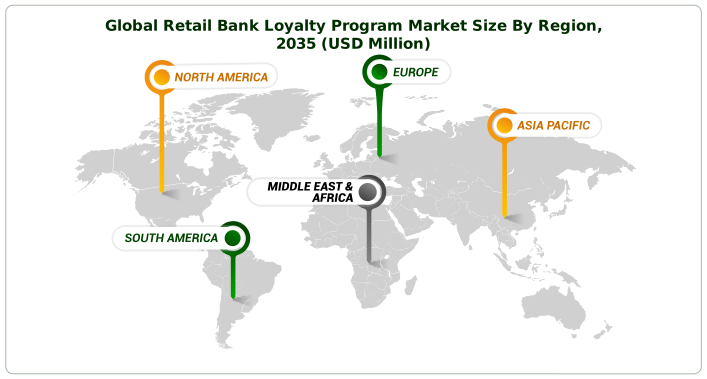
North America is expected to remain the leading regional market, accounting for 34% of global retail bank loyalty program activity. The region benefits from mature retail banking infrastructure, extensive digital payment adoption, established customer-reward practices, and broad availability of banking technology platforms. During 2026, financial institutions are increasingly connecting loyalty programs with mobile applications, card ecosystems, customer analytics, and personalized marketing, supporting continued demand for integrated engagement capabilities.
Large customer portfolios are encouraging banks to automate loyalty administration and customer segmentation across multiple channels. With more than 45% of modern loyalty initiatives expected to incorporate automated segmentation or predictive recommendation capabilities, North American institutions are increasingly using data-driven methods to improve offer relevance. The region's 34% share also reflects the concentration of sophisticated banking operations capable of supporting real-time rewards, partner integration, and increasingly flexible redemption structures across personal and business relationships.
Europe
Europe is projected to hold a 27% share of the global retail bank loyalty program market. The region's established banking sector, strong digital-channel usage, and increasing focus on customer experience are supporting loyalty modernization. During 2026, financial institutions are placing greater emphasis on personalized engagement, transparent reward structures, and digitally accessible benefits, while cloud-based loyalty technologies are helping banks coordinate campaigns across multiple customer touchpoints.
The European market is also influenced by the need for efficient data management and secure customer interactions. Banks serving millions of individual and business customers can use automated segmentation to differentiate offers according to transaction behavior and relationship characteristics. The 27% regional share reflects continued investment in digital banking experiences and loyalty infrastructure, while flexible reward mechanisms are creating opportunities to improve engagement without relying exclusively on traditional points accumulation.
Asia-Pacific
Asia-Pacific is expected to account for 25% of the global retail bank loyalty program market while recording the fastest regional growth at approximately 7.2% CAGR. Rapid expansion of mobile banking, digital payments, fintech-enabled financial services, and smartphone-based customer engagement is creating favorable conditions for loyalty program adoption. Banks are increasingly introducing reward functionality directly into digital banking journeys, allowing customers to view benefits and incentives during everyday transactions.
The region's 25% share is supported by expanding financial inclusion and the growing importance of mobile-first customer experiences. Retail banks can use transaction data to deliver targeted incentives across large and increasingly digital customer populations, while automated campaigns can support engagement at scale. The combination of a 25% current share and approximately 7.2% CAGR indicates that Asia-Pacific will remain an important source of incremental demand through 2035, particularly as banks develop more personalized and integrated loyalty ecosystems.
Latin America
Latin America is projected to contribute 8% of the global retail bank loyalty program market. Growing digital payment usage, expanding mobile banking access, and increasing competition among financial institutions are encouraging banks to explore customer-retention strategies that extend beyond conventional banking services. During 2026, loyalty initiatives are increasingly being connected with digital transaction activity, targeted promotions, and flexible rewards that can encourage recurring customer engagement.
The region's 8% share provides room for further expansion as financial institutions improve digital infrastructure and introduce more sophisticated customer-management capabilities. Programs designed around simple earning and redemption mechanisms can support adoption among customers with different levels of digital familiarity. Banks can also use automated customer segmentation to tailor campaigns across individual and business relationships, helping loyalty platforms scale as digital financial activity continues to increase during the forecast period.
Middle East & Africa
Middle East & Africa is expected to represent 6% of the global retail bank loyalty program market. Digital banking investment, mobile financial services, growing customer expectations, and increasing competition for primary banking relationships are supporting interest in loyalty platforms. During 2026, financial institutions are increasingly examining digital rewards and personalized engagement mechanisms that can operate across mobile channels and online banking environments.
The region's 6% share reflects an emerging loyalty ecosystem with opportunities for technology-led expansion. Banks can use cloud-enabled platforms, automated campaign management, and data-driven customer segmentation to introduce scalable programs without relying entirely on complex physical infrastructure. As digital financial services become more widely adopted, flexible reward structures can help institutions strengthen engagement among personal and business users while supporting broader modernization of customer experience capabilities through 2035.
List of Top Retail Bank Loyalty Program Companies
- FIS Corporate
- Maritz
- IBM
- TIBCO Software
- Hitachi-solutions
- Oracle Corporation
- Aimia
- Comarch
- Exchange Solutions
- Creatio
- Customer Portfolios
- Antavo
Top 2 Companies Market Share
- FIS Corporate: FIS Corporate represents an important competitive participant in the retail bank loyalty program ecosystem, supported by its broader financial technology capabilities and ability to serve large-scale financial institutions. Its estimated share is approximately 9%, reflecting demand for integrated banking technology, digital engagement, data management, and customer experience capabilities across large institutional environments.
- Maritz: Maritz holds an estimated 7% share and participates in loyalty and customer engagement solutions with capabilities relevant to reward strategy, personalization, program management, and customer experience. Its competitive positioning is supported by the continuing shift toward data-informed loyalty design, where financial institutions seek flexible engagement structures that can support multiple customer segments and increasingly digital reward journeys.
Investment Analysis
Investment activity in retail bank loyalty programs is increasingly directed toward cloud infrastructure, customer analytics, artificial intelligence, API connectivity, and automated campaign management. Financial institutions are prioritizing technologies capable of supporting large customer populations while reducing manual administration. With more than 45% of modern loyalty initiatives expected to incorporate automated segmentation or predictive recommendation capabilities, investment is increasingly moving toward platforms that can convert transactional and behavioral information into personalized engagement opportunities.
Investment priorities are also expanding toward mobile-first reward experiences, real-time processing, and flexible program architectures. Banks can reduce implementation friction by adopting modular systems that connect loyalty functions with existing customer and payment platforms rather than replacing entire technology environments. During 2026, investment decisions are increasingly influenced by scalability, integration efficiency, data governance, and measurable engagement outcomes, while the projected 5.3% overall market CAGR supports continued technology spending through 2035.
New Product Development
New product development is increasingly focused on AI-assisted personalization, real-time reward calculations, predictive customer segmentation, and automated offer generation. Loyalty platforms are being designed to analyze multiple behavioral signals and deliver incentives according to customer activity rather than relying exclusively on fixed campaigns. More than 45% of modern loyalty initiatives are expected to incorporate automated segmentation or recommendation capabilities, creating a strong development focus on intelligent decision support and dynamic customer experiences.
Developers are also concentrating on mobile integration, flexible reward engines, and API-based connectivity with banking systems. New solutions can support multiple reward mechanisms within a single platform, allowing institutions to coordinate Points Program, Subscription-based Program, and other loyalty structures according to customer requirements. By 2035, digitally connected loyalty experiences could influence more than 65% of customer engagement activity, encouraging continued development of real-time interfaces, embedded rewards, automated notifications, and personalized customer journeys.
Five Recent Developments
- April 2024: Retail banking loyalty technology development increasingly emphasized cloud-connected reward management, allowing institutions to coordinate customer engagement across digital banking channels and automate selected loyalty processes for large account populations.
- September 2024: Loyalty platforms expanded their focus on AI-assisted customer segmentation and personalized recommendations, supporting more targeted reward campaigns and helping financial institutions process behavioral information across multiple customer interaction points.
- January 2025: Financial technology development increasingly incorporated API-based loyalty connectivity, enabling reward functions to interact more efficiently with payment, card, customer-management, and digital banking environments while reducing dependence on isolated loyalty systems.
- July 2025: Retail bank loyalty solutions increasingly introduced flexible reward configuration, allowing institutions to combine points, recurring benefits, and personalized incentives within broader customer-engagement strategies designed for both individual and organizational relationships.
- March 2026: Loyalty technology development placed greater emphasis on real-time engagement, mobile reward visibility, automated offer selection, and data-driven personalization as banks sought to strengthen digital interactions and improve the relevance of customer incentives.
Report Coverage
The retail bank loyalty program market coverage evaluates Subscription-based Program, Points Program, and Others across Personal User and Business User applications. The analysis considers current technology adoption, customer-engagement strategies, digital banking integration, automated personalization, reward management, and evolving loyalty architectures. Points Program represents an estimated 49% product-type share, while Personal User applications account for approximately 68% of application demand, establishing the principal structural segments examined across the forecast period.
Geographically, the analysis covers North America, Europe, Asia-Pacific, Latin America, and Middle East & Africa. Their respective market shares are 34%, 27%, 25%, 8%, and 6%, which together equal exactly 100%. North America remains the largest regional segment at 34%, while Asia-Pacific is projected to experience the fastest growth at approximately 7.2% CAGR compared with the overall market CAGR of 5.3%. The coverage also considers competitive positioning, technology investment, product development, customer personalization, digital engagement, and market opportunities through 2035.
| REPORT COVERAGE | DETAILS |
|---|---|
|
Market Size Value In |
US$ 1223.04 Million in 2026 |
|
Market Size Value By |
US$ 1951.08 Million by 2035 |
|
Growth Rate |
CAGR of 5.3 % from 2026 to 2035 |
|
Forecast Period |
2026 to 2035 |
|
Base Year |
2025 |
|
Historical Data Available |
2021-2024 |
|
Regional Scope |
Global |
|
Segments Covered |
Type and Application |
Related Reports

-
What will be the projected value of Retail Bank Loyalty Program Market by 2035?
The Retail Bank Loyalty Program Market is projected to reach USD 1951.08 Million by 2035, expanding at a steady pace during the forecast period. Market growth is supported by rising demand, technological advancements, and increasing adoption across major end-use industries worldwide.
-
What is the expected CAGR of the Retail Bank Loyalty Program Market during 2026-2035?
The Retail Bank Loyalty Program Market is expected to grow at a CAGR of 5.3% during the forecast period from 2026 to 2035.
-
Which companies are leading the Retail Bank Loyalty Program Market?
Key players in the Retail Bank Loyalty Program Market market include FIS Corporate, Maritz, IBM, TIBCO Software, Hitachi-solutions, Oracle Corporation, Aimia, Comarch, Exchange Solutions, Creatio, Customer Portfolios, Antavo
-
How large was the Retail Bank Loyalty Program Market in 2025?
The Retail Bank Loyalty Program Market was valued at USD 1161.48 Million in 2025, reflecting strong demand and continued adoption across major industries.

